What does ductwork and duct cleaning cover?
Best HVAC Toronto designs, installs, cleans, repairs, and balances residential and commercial ductwork, and clears dryer vents to prevent lint fires. The duct system is the part of a heating and cooling installation that homeowners think about least and that determines comfort most. You can install excellent equipment and still have a cold basement and a hot upstairs if the distribution is wrong.
We will also be direct about duct cleaning, because it is the most oversold service in this industry. Cleaning genuinely helps after renovation or construction work, after a rodent or insect problem, where there is visible debris or biological growth at the registers, and when a home has been vacant. In a well-maintained house with a decent filter and no visible contamination, the measurable benefit is small, and a filtration or ventilation upgrade usually does more for air quality than repeat cleaning. We inspect the runs before quoting and tell you which situation you are actually in.
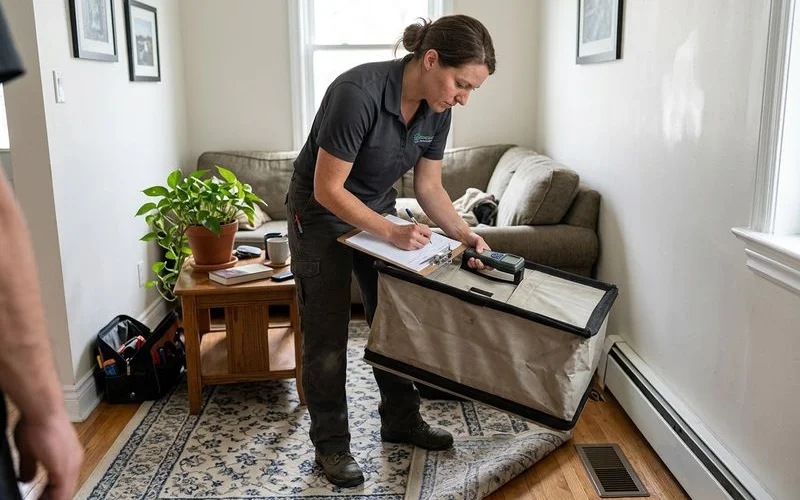
Where we can nearly always help is airflow. If a room never reaches temperature, the usual cause is distribution rather than furnace capacity. We measure static pressure across the air handler and airflow in CFM at each register, which turns an argument about equipment size into a specific, fixable finding.
What is included in a duct cleaning
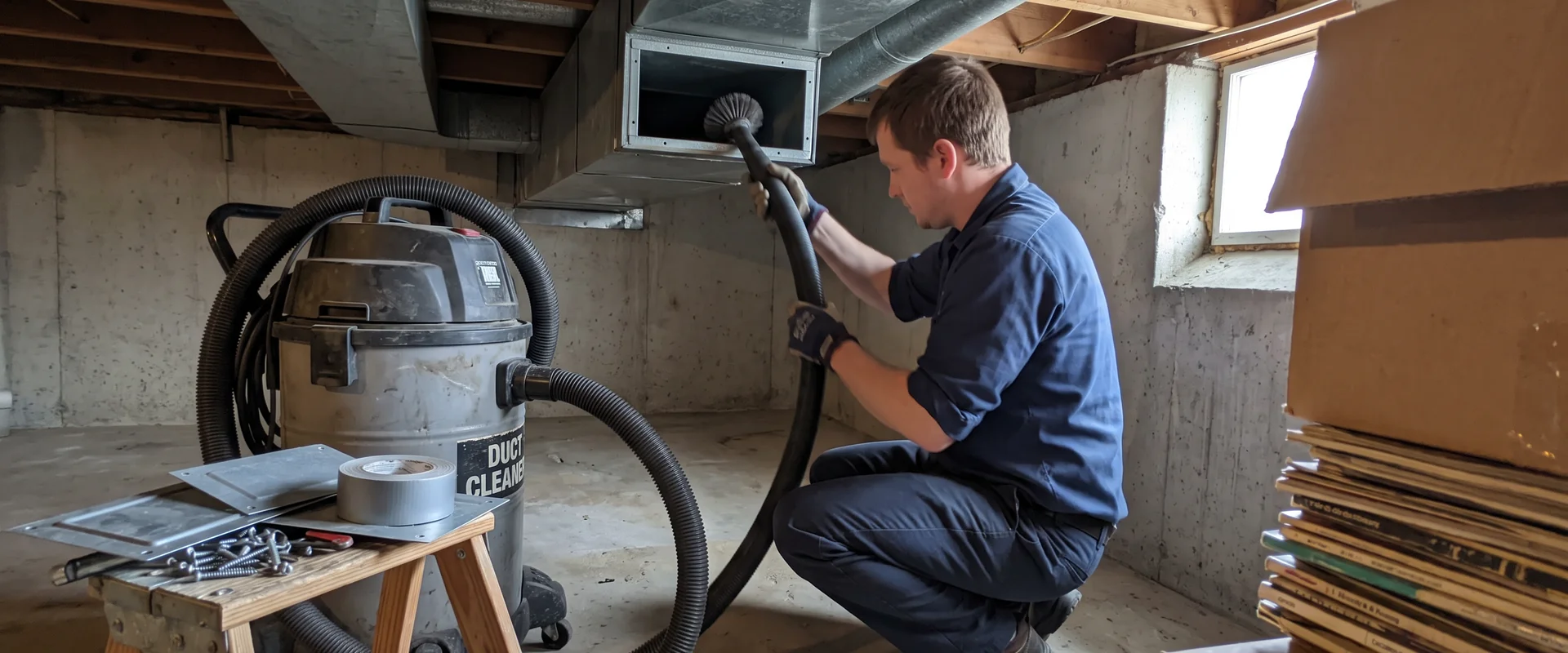
Inspection and photographs of the runs, rotary brush agitation with a negative-pressure vacuum on the trunk, cleaning of all accessible supply and return runs, register and grille cleaning, furnace blower compartment cleaning, filter replacement, and post-work airflow verification.
Common ductwork problems in Toronto homes
Not enough return air
The most common fault in post-war Toronto housing. Many Scarborough and North York bungalows were built with one central return, and when the basement was finished years later, nobody added another. Air cannot get back to the furnace, so it cannot be delivered either. Look for doors that drift shut, whistling under closed doors, and rooms that never quite reach temperature.
Long, undersized, or crushed runs
Flexible duct pinched behind a joist, a run stretched to the far corner of an addition, or a takeoff that was never sized for the room it serves. All produce the same result: not enough air arriving where it is needed.
Unsealed joints in unconditioned space
Ductwork in an attic, garage, or crawlspace leaks heated and cooled air into spaces you are not trying to condition. Sealing accessible joints with mastic is cheap and effective.
Ductwork never rebalanced after a renovation
Finishing a basement, adding a second floor, or converting an attic changes the heating and cooling load of the house. Systems that were balanced correctly in 1975 are rarely still balanced today.
Dryer vents packed with lint
A separate issue but one we are asked about constantly. A restricted dryer vent makes the appliance run far longer than it should and is a genuine fire risk. If clothes need two cycles, check the vent before blaming the dryer.
What affects ductwork and cleaning cost?
For cleaning, the drivers are the number of supply and return runs, the size of the home, and access. A compact East York semi with eight runs sits at the lower end of the $400 to $800 range; a large Vaughan home with twenty runs across three levels sits at the upper end.
For ductwork modification, the cost depends on how much needs changing and how accessible it is. Adding a return in an unfinished basement is straightforward. Running a new supply to a finished attic bedroom means opening and repairing finished surfaces, which is the larger part of the cost. New trunk runs for an addition are quoted per project after a load calculation.
For diagnostics, we would rather charge for an airflow survey and give you a specific answer than sell equipment that does not address the cause. Where duct correction turns out to be unnecessary, we will say so, and that visit will have saved you the price of a furnace you did not need.