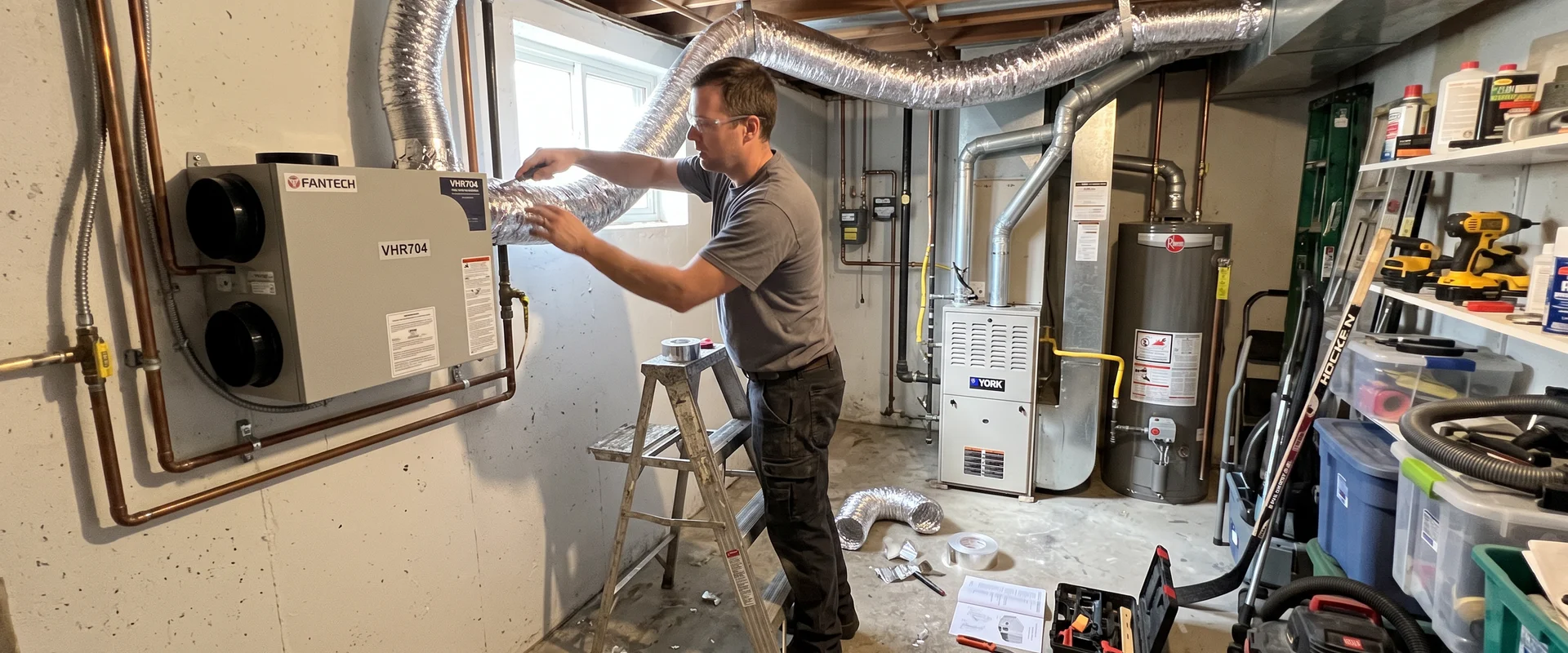
Technician installing a heat recovery ventilator with insulated ducting in a Toronto basement

Whole-Home Indoor Air Quality Systems in Toronto

Last updated:

HRV and ERV installation, humidifiers, UV air purification, and smart thermostats for whole-home air quality management.

  • TSSA G1/G2 certified
  • 20+ years experience
  • 2-Year Labour Warranty

Quoted after assessment — quoted per system after an on-site assessment

  • 4.9 (150+ reviews)
  • TSSA G1/G2 Certified & $2M Insured
  • 2-Hour Emergency Response
  • 2-Year Labour Warranty

Common problems

Sound familiar?

Stale, dry, or dusty air despite a working HVAC system

Ventilation, humidity, and filtration are separate problems from heating and cooling. We diagnose which one is actually causing the discomfort.

Family members with allergies or breathing issues at home

HRV/ERV ventilation and filtration upgrades address indoor air quality directly, rather than just running the furnace fan more.

A thermostat that doesn't actually save you money

Smart thermostat installation only helps if it's set up and integrated correctly. We configure it to your system and your schedule.

What does whole-home indoor air quality actually involve?

Indoor air quality covers four separate things, and confusing them is the reason many homeowners buy equipment that does not solve their problem. Ventilation exchanges stale indoor air for fresh outdoor air. Filtration removes particles from the air already circulating. Humidification and dehumidification manage moisture. Purification targets biological growth. A house that feels stuffy needs ventilation. A house that feels dry needs humidification. Those are different products, and buying the wrong one is a common and expensive mistake.

So we measure first. On an air quality visit we take relative humidity readings in several locations, measure static pressure across the air handler to establish what your ductwork can tolerate, check the filter type and its actual condition, inspect the evaporator coil and drain pan, and look at any existing ventilation equipment. Most Toronto homes with an HRV installed at construction have never had it balanced or its core cleaned, which means it is running as an expensive fan.
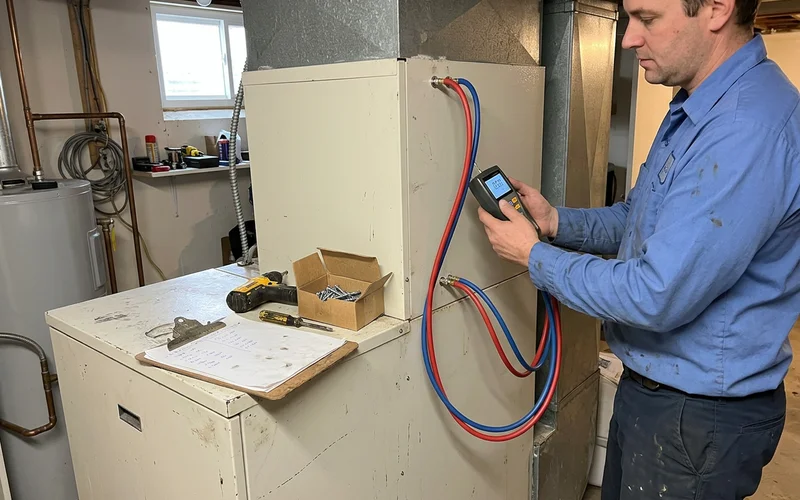
Technician measuring static pressure across a furnace air handler with a digital manometer before recommending a filtration upgrade

The static pressure reading matters more than most people realise. Every filter, humidifier, and UV housing you add to a duct system creates resistance. A MERV 16 filter fitted to ductwork that was already marginal will starve the blower, reduce heating and cooling output, and shorten the motor’s life. We specify the highest filtration your system can genuinely breathe through, which in most Toronto homes is MERV 11 to 13 in a deep-pleated media cabinet.

What we install

HRV and ERV ventilation

Balanced mechanical ventilation that brings in fresh air while recovering heat from the air being exhausted. Essential in tight, modern homes across Markham, Vaughan, Milton, and newer Pickering developments. We install new systems and, just as often, service, clean, and properly balance existing ones that have never been commissioned.

Whole-home humidifiers

Bypass humidifiers are the cost-effective standard and work whenever the furnace runs. Steam humidifiers produce moisture independently, deliver more capacity, and hold a target more precisely, which suits larger or leakier homes. Either way, the humidistat needs to reduce the target as outdoor temperatures drop, or you get condensation and frost on the windows.

Filtration upgrades

Replacing a one-inch throwaway filter with a four or five inch deep-pleated media cabinet gives dramatically more surface area, which means better particle capture at lower resistance and yearly rather than monthly changes.

UV-C purification

A germicidal lamp at the evaporator coil prevents biological growth on the coil and in the drain pan, which is where musty summer air conditioning odours come from. That is a real, measurable benefit, and we describe it as exactly that rather than promising whole-house sterilisation.

Smart thermostats

Scheduling, geofencing, humidity display, filter reminders, and remote access. They matter most with staged, modulating, or heat pump systems where the thermostat actively manages how the equipment runs.

What affects indoor air quality system cost?

Equipment type is the largest factor: a media filter cabinet is a few hundred dollars, a humidifier under a thousand, and a full HRV or ERV system with dedicated distribution ductwork considerably more. Second is the distribution method. An HRV integrated into existing ductwork is far less involved than one with dedicated supply and exhaust runs to individual rooms.

Third is your existing ductwork. If static pressure is already high, correcting the airflow problem needs to come before, or alongside, any air quality upgrade. That is not an upsell; installing restrictive equipment on restricted ducts simply makes the house less comfortable.

Fourth is controls, since a steam humidifier with an outdoor-reset humidistat costs more than a basic bypass unit on a manual control. We assess all of this on site and quote each recommended component separately, so you can decide what to do now and what to leave for later.
Transparent pricing

How much does air quality cost in Toronto?

Air quality equipment is quoted individually because the right answer depends on your ductwork, home size, and the problem you are solving.

Written quote before any work begins. No hidden fees.

Filtration upgrade

Media filter cabinet

Starting from $ 700 quoted per system after an on-site assessment

  • Deep-pleated MERV 11 to 13 cabinet
  • Static pressure verified after fitting
  • Yearly filter changes instead of monthly
  • Fitted to existing ductwork
Get a quote
MOST COMMON

Whole-home humidifier

Bypass or steam

Starting from $ 900 quoted per system after an on-site assessment

  • Bypass or steam humidifier
  • Humidistat control
  • Water supply and drain connected
  • Winter humidity set correctly
Get a quote

HRV or ERV system

Balanced ventilation

Starting from $ 2,800 quoted per system after an on-site assessment

  • Heat or energy recovery ventilator
  • Dedicated or duct-integrated distribution
  • Balanced supply and exhaust flow
  • Controls and commissioning
Get a quote

Prices are guide ranges for Toronto and the GTA. Final pricing depends on your equipment, access, and site conditions, and we confirm it in writing before starting. Request a free estimate or call 647-254-4113.

Financing available on approved credit, plus lease-to-own with zero down on qualifying installs.

Why us

Why choose Best HVAC Toronto for air quality?

We measure before we sell

Air quality is the easiest area of HVAC to oversell. We take humidity and static pressure readings and recommend only what your readings justify.

Airflow protected

A MERV 16 filter on ductwork that was already restricted will starve the furnace. We check static pressure and specify filtration your system can actually breathe through.

Balanced ventilation, properly

An HRV that is not balanced either pressurises or depressurises the house, which can affect appliance draft. We balance and document the flows.

Set for a Toronto winter

Humidity targets need to drop as it gets colder or you get condensation on windows. We set the humidistat correctly and explain the seasonal adjustment.

How Best HVAC Toronto compares

Feature Typical provider Best HVAC Toronto
Recommendation basis Package upsell Humidity and static pressure readings
Filtration choice Highest MERV available Highest MERV your ductwork can handle
Ventilator setup Installed and left on default Supply and exhaust balanced and documented
Humidity control Single fixed setting Seasonal targets explained and configured
Labour warranty 1 year 2 years

How it works

How does our air quality service work?

  1. 1

    Identify the actual problem

    Dry air, stuffiness, dust, odours, and condensation all have different causes. We measure humidity and airflow before recommending equipment.

  2. 2

    Check the ductwork can take it

    Higher-MERV filtration and added components raise static pressure. We measure it first so an air quality upgrade does not become an airflow problem.

  3. 3

    Install

    Most single components are a half-day job. HRV and ERV systems with dedicated distribution take a day or two depending on the duct route.

  4. 4

    Balance and set up

    We balance supply and exhaust flow on ventilators, set humidistat targets for a Toronto winter, and show you the maintenance routine.

Not sure what your air quality situation needs?

Get a straight answer and a written price, with the numbers to back it up. No pressure, no scare tactics.

Our work

Recent air quality projects

Click any image to enlarge.

Reviews

What customers say about our air quality work

4.9 out of 5 from 150+ customer reviews

They explained exactly what they found rather than just selling us equipment. The humidifier has made a real difference to winter comfort.

MMeena R.Bayview Village, North York

Straightforward advice in plain language instead of a brochure. They fitted a better filter cabinet and checked the airflow afterwards.

YYuki H.Unionville, Markham

Fixed the underlying airflow problem first and only then recommended the air quality upgrade. That order of operations saved us money.

EErrol M.Guildwood, Scarborough

FAQ

Air Quality questions, answered

What is the difference between an HRV and an ERV?

Both exchange stale indoor air for fresh outdoor air while recovering heat from the air being exhausted. An HRV transfers sensible heat only. An ERV also transfers moisture, so it retains some humidity indoors in winter and rejects some incoming humidity in summer. In Toronto's climate, HRVs suit tighter homes that tend toward high winter humidity, while ERVs suit homes that get uncomfortably dry.

Do I need mechanical ventilation in an older Toronto home?

Older, leakier homes get a lot of unintentional air exchange through the building envelope, so a full HRV is often unnecessary. Newer, tighter homes across Markham, Vaughan, Milton, and the newer Pickering developments genuinely need mechanical ventilation, and most were built with an HRV that has never been serviced or balanced. We check what you have before recommending anything new.

What humidity level should I run in winter?

Aim for roughly 35 to 40 percent when it is around freezing, dropping toward 25 to 30 percent when outdoor temperatures fall below -15. Higher settings feel more comfortable but cause condensation and frost on windows, which over time damages sills and frames. If your windows are streaming, the humidistat is set too high for the outdoor temperature.

What MERV rating should my filter be?

MERV 11 to 13 is the sensible range for most residential systems, capturing fine dust, pollen, and a good share of smaller particles. MERV 16 captures more but creates significantly more resistance, and on ductwork that is already restricted it will starve the blower and reduce heating and cooling performance. We measure static pressure and specify what your system can actually handle.

Do UV air purifiers work?

Germicidal UV-C lamps installed at the evaporator coil are genuinely effective at preventing biological growth on the coil and in the drain pan, which is where musty odours in air conditioning usually originate. Claims about whole-house air sterilisation are considerably more optimistic, since air passes the lamp too quickly for full inactivation. We install them for coil hygiene and describe the benefit honestly.

Why is my house so dry in winter?

Cold outdoor air holds very little moisture, so when it enters and is heated, the relative humidity falls sharply. The drier your house feels, the more air leakage it usually has. A whole-home humidifier addresses the symptom effectively. Air sealing addresses the cause and also lowers heating bills, so where the leakage is obvious we will mention it.

Bypass or steam humidifier: which is better?

A bypass humidifier is less expensive and works well in most homes, but it only adds moisture while the furnace is running. A steam humidifier produces moisture independently of the furnace, delivers more capacity, and holds a target more precisely, which suits larger homes and those with high air leakage. It costs more and uses more electricity.

How often does air quality equipment need servicing?

Humidifier pads or steam canisters should be replaced annually before the heating season. HRV and ERV cores and filters need cleaning at least twice a year, and the exterior hoods checked for blockage. Media filter cabinets typically need changing once a year rather than monthly. UV lamps lose output over time and are usually replaced annually.

Will a smart thermostat actually save money?

Modest savings from better scheduling and geofencing, yes, though the bigger benefits are usually comfort and visibility: humidity display, filter reminders, and remote control during a cold snap. Smart thermostats matter more with staged, modulating, or heat pump equipment, where the thermostat plays an active role in how the system runs rather than simply switching it on and off.

Can air quality equipment help with allergies?

It can help meaningfully. Better filtration reduces airborne pollen and dust, humidity control in the 35 to 45 percent range suppresses dust mites and mould, and ventilation dilutes indoor pollutants. It is not a cure, and we would rather set realistic expectations than promise more than the equipment delivers.

24/7 for gas emergencies, red tags, no-heat and no-AC

Ready to book air quality?

HRV and ERV installation, humidifiers, UV air purification, and smart thermostats for whole-home air quality management. Written quotes before work begins, and a 2-year labour warranty.

  • 2-year labour warranty
  • Written quotes before work starts
  • TSSA G1/G2 certified, WSIB covered
Call Now