How does a tankless water heater work?
A conventional tank keeps 150 to 250 litres of water hot around the clock whether you use it or not. A tankless unit heats water only when a tap opens, firing a condensing heat exchanger and raising the water temperature as it flows through. Nothing is stored, so nothing sits losing heat, and you cannot run out of hot water part way through the third shower of the morning.
The trade-off is that a tankless unit is limited by flow rate rather than by volume. Capacity is expressed as gallons per minute at a given temperature rise, and that is where most disappointing installations go wrong. A unit rated at 6 GPM is quoted at a temperature rise measured under mild conditions. Toronto’s municipal water arrives considerably colder in February than in August, so the same unit might only manage 4 GPM at the same output temperature in the middle of winter. We size on the winter figure, counting fixtures and realistic simultaneous use, because that is the condition your household will judge it by.
The other pre-install check that matters is gas supply. A tank water heater might draw 40,000 BTU. A tankless unit firing flat out draws 150,000 to 199,000. Half-inch supply piping that was perfectly adequate for the tank frequently is not adequate for the tankless, and undersized gas supply produces poor performance and nuisance error codes. We calculate the load and quote any required gas line upsizing up front.
What is included in every tankless installation
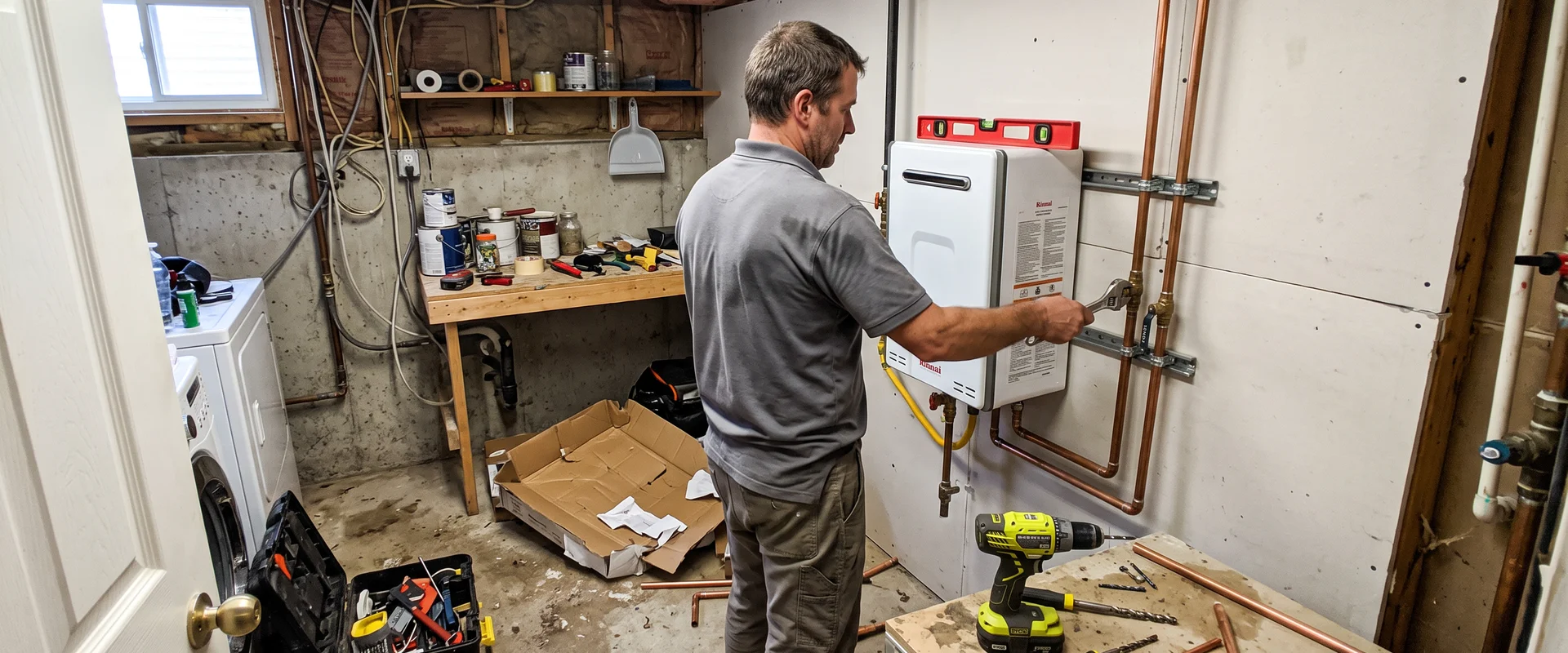
Household flow-rate sizing, gas load calculation, removal and disposal of the old tank where applicable, wall-mounted condensing unit, isolation valve kit for future descaling, new concentric or power direct venting, condensate drainage and neutralisation, gas piping modifications where required, full commissioning with gas pressure verified under load, and a 2-year labour warranty alongside manufacturer coverage.
Is tankless the right choice for your home?
Tankless usually wins when
You regularly run out of hot water, you have three or more bathrooms, you want the mechanical room floor space back, you are already replacing venting or gas piping for other reasons, or you plan to stay in the home long enough to recover the higher install cost through lower standby losses.
A high-efficiency tank is often better when
Demand is modest and predictable, the mechanical room already accommodates a tank comfortably, the gas supply would need substantial upsizing, or you are selling within a few years. We are happy to quote both and let you compare.
Maintenance is not optional
Annual descaling is what separates a tankless unit that lasts 20 years from one that fails in 10. Mineral scale builds inside the heat exchanger, restricting flow and eventually triggering fault codes. Because we fit isolation valves on every installation, the annual flush is a quick, inexpensive visit rather than a job requiring pipework.
What affects tankless installation cost in Toronto?
Flow-rate capacity comes first: a higher GPM unit for a larger household costs more than an entry model. Second is what you are replacing. Swapping an existing tankless for a new one is the cheapest path since venting and gas supply are usually already correct. Converting from a tank means new venting, condensate management, and often gas upsizing.
Third is the venting route. A unit that can terminate through a nearby exterior wall is straightforward; one needing a long run through finished space costs more. Fourth is gas piping, which is the single most common reason a tank-to-tankless conversion costs more than people expect. Fifth is optional extras such as a recirculation loop for near-instant hot water at distant fixtures.
Every one of these is assessed during the free estimate and itemised in a written quote before we begin.